Note: The street running through the center of Greenbrier in 1963 is Verde Drive. The two schools are not marked in the photos because when I made them for the book the print would have been illegible.


Was Greenbrier unique enough of a place to grow up to make it a worthy topic for a book?
Much of the experience of growing up in the Greenbrier subdivision during the Cold War was common to many middle-class American communities from coast-to-coast and very representative of Chicago suburban life. What makes Greenbrier a worthy topic, is that American communities, culture, and family life have all changed over time. Some of the changes that have taken place have been by design, while others are a result of changing technology. Regardless of whether one believes the evolution of American society has been for better or worse, the experience of having grown up in a place like Greenbrier has become very unique. I wrote the book with the ultimate goal of transporting the reader to that time and place to observe American family life that is part of an irretrievable American past.

Greenbrier in 1975
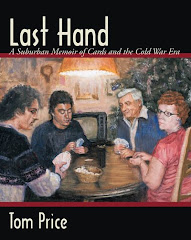
The video trailer provides a glimpse into the world of my book, Last Hand: A Suburban Memoir of Cards and the Cold War Era.
The embedded video is the first view of the video trailer I will be spreading around the internet. I will also post a youtube version with reviews. I you enjoy the clip feel free to help spread the word.

The news of Walter Cronkite’s death may not seem too significant to younger Americans. And while I wasn't a huge fan of Walter Cronkite in later years, there is little doubt as to his influence on the American psyche of his time. There have been many newscasters since but there was something about Walter Cronkite that made him unique that is difficult to describe to a younger person. To say simply he was the most trusted man on TV doesn’t convey what that really meant at that time. It’s hard for a twenty-something to have a feel for the cultural significance of network TV before the advent of cable. And Walter Cronkite was THE TV Network anchorman icon of the Cold War Era. It wasn’t that the majority of people knew Walter Cronkite, it was that EVERYBODY knew Walter Cronkite. He was part of American culture – like Coca-Cola.
Ed McMahon also died recently. Like Johnny Carson and Walter Cronkite, it was as if a family member had passed away. These people where part of your family every evening.
Today there are hundreds of shows and channels to choose from on TV. And there is the internet to occupy our time. Although the country is still tied up to mass media culture, it’s no longer a unifying force but rather a divisive one. Walter Cronkite really represents another America, one that was gone before he died.
When I was a little boy of about four or five, I used to love Disney movies like Mary Poppins and Chitty Chitty Bang Bang. I enjoyed the songs and the creative dancing. I guess that’s not so uncommon for a little kid. But there was something about Chitty Chitty Bang Bang that always freaked me out slightly; the Child-Catcher.
The Child Catcher serves the evil Baroness of Vulgaria (a country were children are imprisoned). Regardless of how brave I may have been as a five year old, the Child Catcher always scared me. Probably because he was so freaky looking with his long straight black hair, pale skin, and oddly shaped nose. He dressed all in black but darned a colorful robe to entice children.
The scene where the Child Catcher kidnaps two of the children in the story is always what frightened me most. He disguised what was a caged carriage to look like a circus carriage, like one you might see at an amusement park, to ensnare the kids. He was sneaky offering the kids sweets and goodies as he sung out to them.
You’re probably wondering, why, at the age of forty-two, would I be thinking of the Child Catcher from Chitty Chitty Bang Bang? Well, that should be obvious. His funeral has been shown on just about every TV station in the country. I know what you’re thinking…”No, Tom, that’s Michael Jackson’s funeral.” But I’m here to say, I think Michael Jackson transformed himself into the Child Catcher from Chitty Chitty Bang Bang. If not, it’s a bizarre coincidence. I mean, it’s bizarre several ways. First, is the fact that when the movie came out in 1968, Michael Jackson was an impressionable nine years old. Second, is the unusual similarity in appearance. And the third weird connection would be the child molestation charges combined with the enticing Neverland ranch.
What puzzles me is our culture’s fascination with Michael Jackson. Sure, he was very talented but there many talented people on TV and radio. His music was very popular but there are other popular artists like the Beatles who I think are tied to the culture. If I’m around when Paul McCartney dies, I don’t expect around-the-clock coverage on every channel. I must be completely out of touch because I can’t think of anyone whether entertainer or world leader or anyone in between that should be covered by the media as Michael Jackson’s death has been treated. Maybe I can’t relate simply because he reminds me so much of the Child Catcher. At least I can finally put that childhood fear to rest today.
1. Never send a boy to do a man’s job. (A phrase commonly used when playing cards—such as if a player underestimated what was needed to succeed, by playing too low a card, only to lose it to a higher card.)
2. Now that’s an “I gotcha!” (Referring to when someone gets duped or cheated.)
3. Come on, clown! (A reference to all other drivers on the road, while Dad was driving.)
4. Devil hates a coward. (Commonly used when preparing to take a risk or chance.)
5. Know what I mean, jelly bean?
6. Do I have to get your attention? (A phrase you didn’t want to hear as a kid. Having Dad get your attention meant getting smacked for not behaving or following directions—but at least we got a warning!)
7. Just like downtown. (Commonly used upon completion of something done correctly and efficiently.)
8. Ragamuffin. (A poor ragged child—an appearance I commonly had during the summer months of the ‘70s. My son thought I made this word up.)
9. Misery loves company! (Dad’s way of saying, if he had to suffer through something, I should join him.)
10. Eat to live, not live to eat. (A Ben Franklin quote that Dad liked. Ironic coming from Dad, who later claimed he was on the “See Food Diet”—everything you see, you eat.)
'70s song of the day, The Night They Tore Ol Dixie Down by The Band

In honor of the quickly approaching Father’s Day, I’ve decided to add some stories of my father over the course of the next several days. Some of the stories will be funny and some serious but all have a message. While these are stories of my father, I don’t think they are necessarily unique to him, but reflect many attitudes of his generation as well as American culture of his age. I think the story below illustrates this best.
The Golden Rule
While I was a college student in Murray, Kentucky, I didn’t own a car, and I only traveled home on vacation breaks. Dad always made arrangements to pick me up. On one such occasion, an acquaintance of mine called me to ask if I was going to Chicago for Thanksgiving break. She wanted to know if I could take a friend of hers to meet his sister in Chicago. I told her I could, and arranged a time to meet her friend. Her friend turned out to be a foreign exchange student from Columbia, aptly named Columbio.
Columbio stood five foot seven, and was slightly plump, with dark hair and large glasses like Harry Caray. Although he was likely twenty-something, he looked like he was in his late thirties. I only spoke with him briefly, to arrange our departure time. Before we picked him up, I really didn’t know anything about him, other than he wanted to get to Chicago to meet his sister. I called Dad and explained we’d be bringing Columbio along, which of course was fine with him.
It wasn’t unusual for us to drive other students to Chicago during school breaks. Dad arrived a day ahead of time, and we’d get dinner, before he picked me up early the following day. The day came for us to drive to Chicago, and Dad was right on time as usual, so we packed up and headed home.
In the car, we began to make small talk with Columbio, which was a challenge at times as he struggled with the language. Dad was always a little funny around foreign students—he prompted them to tell him how much they liked America how nice it was to be here. In our discussions with Columbio, we discovered that he planned to get a hotel room somewhere in the city, then call his sister after his arrival and arrange to meet her the next day. Dad thought this was crazy. We had a spare room, so Dad offered it to Columbio, and told him we’d help him meet up with his sister.
Columbio stayed with us that night, and the following day we headed to the studio at Columbus Plaza while we waited for his sister to arrive. As it turns out, she didn’t know the city very well, and it took some time for her to meet up with us. Dad played tour guide while we waited--he gave Columbio a map of the city and told him how to get around. Columbio probably understood a third of what Dad said, but it was a nice gesture nonetheless. We also carefully arranged the time and place to pick him up for the return trip to Kentucky. He really went out of his way to help Columbio, someone he barely knew. That was Dad—always sticking to the Golden Rule.
'70s song of the day: "I Got a Name" by Jim CroceWhen there were only seven channels on the TV to choose from, many of us watched the same shows and consequently saw the same commercials. And we saw them over and over again. Certain commercials had jingles that are hard to forget. Some of those jingles were nationally promoted products like Coca Cola and McDonalds but some of them were regional.
I’m sure there are people my age who know their own regional jingles that I would never recognize. There are of course many from the Chicago area that I’ll never be able to forget. Many can be found on a website I came across called fuzzymemories.tv. If you’re from the area or are curious about past Chicago TV culture, you should check it out.
Here’s one of my favorites: Call Boushelle now at Hudson 3-2700
'70s song of the day, "Black Water" by The Doobie Brothers
I hope as I address these topics you’ll join in with your thoughts, opinions, and memories. And if you haven’t already, perhaps you’ll take a look at my book and join my family, if even just for a moment.