Friday, April 23, 2010
The Wish Book
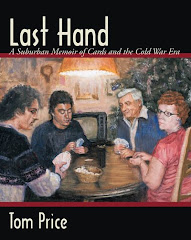
In the book, Last Hand: A Suburban Memoir of Cards and the Cold War Era, I write about using the Sears Wish Book for my Christmas list inspiration. Although I have a few old copies of the Wish Book, I’ve decided to attach a few pages from the 1975 catalog. If you want to write down your memories of what you wanted as a child, I might be able to find a matching page. Some of the catalogs (JC Penny, Spiegle, Wards and Sears) date back to the mid-1940s. Click on the images for a closer view.
Thursday, March 4, 2010
Better Late Than Never
Long before becoming a visual effects artist, my brother, Steve Price, went to Buffalo Grove High School. And it was during his senior year that he was tasked with designing the cover of the yearbook. I’m not sure if he came up with the idea of modeling the yearbook after the board game Life but it wouldn’t have been unusual for his creative personality. I do know he put forth a lot of effort to make a pretty cool cover design, artwork and captions for the game. What makes the design special is that it truly captures the spirit of high school life at Buffalo Grove during those days.
Of course, only people who were staff or students during the 1979 school year (or had siblings who were) had a chance to see the yearbook. For that reason I’ve posted copies of Steve’s work here for others to view. Click on the image for a closer view.
Well, having watched Steve work on the cover I think that would have applied to him. However, the funny thing is the one person who wasn’t credited for working on the book was Steve. In fact, the only sign Steve worked on the cover was his signature on the back cover image. So, I guess, I’m giving him his proper credit now.
Of course, only people who were staff or students during the 1979 school year (or had siblings who were) had a chance to see the yearbook. For that reason I’ve posted copies of Steve’s work here for others to view. Click on the image for a closer view.
There is an ironic side story that goes with the yearbook. It seems the Editor-in-chief, Nancy Wetzell, was disappointed with the lack participation of the student body in the effort to produce the yearbook that year (apparently a number of students quit during the school year) and in the Editor’s Statement wrote, “Students should be more willing to give of themselves and their talents for the betterment of the entire school.”
Well, having watched Steve work on the cover I think that would have applied to him. However, the funny thing is the one person who wasn’t credited for working on the book was Steve. In fact, the only sign Steve worked on the cover was his signature on the back cover image. So, I guess, I’m giving him his proper credit now.
Labels:
Arlington Heights,
Art,
Buffalo Grove High School,
Steve Price
Thursday, February 25, 2010
Vintage Hasbrook Ad
While doing research on the Arlington Heights subdivision, Greenbrier, for Last Hand, I came across a number of Ads for neighboring subdivisions. Once such Ad was for Hasbrook, which is the subdivision just south of Greenbrier across Palatine Road. Click on the image for a closer view.
Thursday, February 11, 2010
Fourth of July Bike Parade
It's been a long time since the kids of Greenbrier decorated their bikes for the Fourth of July bike parade that ran through the neighborhood. In the book, Last Hand: A Suburban Memoir of Cards and the Cold War Era, I describe my family’s involvement in the 1973 bike parade. While looking for some references of the bike parade, I came across this footage of the 1964 Greenbrier Fourth of July bike parade which was filmed before the subdivision’s completion. I hope you enjoy it.
To learn more about the book, Last Hand, read excerpts, watch a video preview, and even get an autographed copy go to http://www.lasthandthebook.com/
Saturday, February 6, 2010
1961 Arlington Heights Zoning Map
While writing the book, Last Hand a Suburban Memoir of Cards and the Cold War Era, I discovered an old 1961 zoning map my dad had obtained (probably around the time he put his down payment on the house in Greenbrier in October 1961). What is interesting about the map is that it captures a moment in time when Arlington Heights was expanding. Greenbrier, which is at the very top of the map, is the first area north of Palatine road that Arlington Heights annexed. This was also a time when Route 53 was still in the planning stage. Click on the image for a full view.
Sunday, December 27, 2009
Take Me Out to the Ball Game
When I was ten years old my dad took the family out to Wrigley Field to see the Cubs play the Cincinnati Reds. The date was July 28th and it was a remarkable game. It was remarkable for several reasons; one was both the Chicago Cubs and the Cincinnati Reds had some all time great players including Pete Rose and Johnny Bench for the Reds and Bill Buckner and Bruce Sutter for the Cubs. The other reason was the game turned out to be one of the longest and highest scoring games in Cubs’ history. After thirteen innings, several hotdogs, a container or two of Borden’s Frosty Malt, the Cubs won the game 16 to 15. I came across the old 25 cent program today. Attached is an image of the inside page—click on the image to get a better view.
Tuesday, December 15, 2009
The Area North of Greenbrier
During the early 1970s the area around Greenbrier began to expand. One small development of single family homes called Cedarbook was added almost as an extension of the original Greenbrier neighborhood. One project that was never completed was called Randhaven. Randhaven was to be multi-family housing units not too different from Greenbrier Apartments. But the builder ran out of money and as seen in this view of the area in 1975 the buildings were left unfinished. There they stood for several years. As a kid they presented just another adventure. As I talk about in Last Hand there were many things to do in the Greenbrier area such as unauthorized fishing, roaming the nursery, and going to the White Hen. Rand Haven was unique because it was like having your own local war ruins. Most of the buildings were void of any roofing, all that stood there was concrete, bricks and some stone rubble. If you had the nerve to enter one of those death traps, you'd also find the rusty iron stairwells to climb. The days of adventure with Randhaven lasted several years. Eventually the area would be cleared and build up at the Pointe Apartments.
Click on the picture for a closer view.
Subscribe to:
Posts (Atom)